Check out our latest pictures in the photo gallery!
|
Welcome to Montgomery Mini Herefords
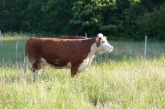
Miniature Herefords are full blooded Herefords and are registered through the American Hereford Association. Like other Herefords, they are primarily used as a beef animal. These cattle are a result of a specific breeding program spanning more than 50 years. Miniature Herefords are about 30-50% the size of traditional Herefords.
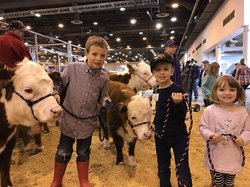
The ideal conformation and breeding characteristics of a miniature Hereford are the same as traditional Herefords. One judges the quality of these cattle in a similar manner – good bone structure, depth, functionality, soundness and indication of high carcass quality. The primary difference being height – an adult Miniature Hereford Cow can not be taller than 46” at the hip, while a Bull can not be taller than 48” at the hip. Why Miniature Herefords? Miniature Herefords are the ideal animal for smaller ranches/acreage, young children or people that love cattle for one reason or another yet do not have the time, space or patience for the requirements of running large cattle. Mini Herefords do not require vast fences, pens or chutes and are easily kept within most types of fencing. They may be considered pets, enjoyed as a hobby, treated as a secondary source of income, employed as a full time business or simply used for the benefits of an agricultural exemption. Miniature Herefords are naturally docile, can be easy to handle and make excellent show animals for any level of competition. Two or three may be kept in place of one standard size cow. A miniature cow will wean a calf weighing a higher percentage of her mature weight, thus making them much more economical and efficient. As a result of their smaller statue, miniature Herefords require approximately half the amount of grain and hay as their larger counterparts and overall, result in an animal that is more efficient to maintain. Miniature Herefords exhibit an improved cow/calf weaning ratio, greater rib eye area per hundred weight, a higher dressing percentage and increased tenderness due to shorter muscle cell structure, genetics and early maturity. These traits are outstanding when compared to the modern beef animal. |